Affichage des articles dont le libellé est footprint. Afficher tous les articles

mercredi 3 juillet 2013

The CO2 compensation of Coutiver - La compensation CO2 de Coutiver


Since I was a teenager I have been preoccupied by the various environmental problems that are present today, I always wanted to reduce my carbon footprint in my everyday activities.
It is obvious that I apply those principles to Coutiver.

A lot of these actions are already in place and we are continually working on social informative and environmental projects.


What is the CO2 Compensation?

It is the actions that are performed by people or companies to minimize or compensate for the carbon dioxide that they exhaust within the atmosphere.
In general those efforts are put to waste treatment, the energy usage, and environmental activities and support, etc.


We don’t forget Recycling!

I choose the ingredients and the packaging of the soaps, I also choose the delivery packaging, the tools and other objects used in Coutiver by origin (locally if possible), by composition (recycled, recyclable or biodegradable matters) because everything has an afterlife and is also sustainable (the longer it lasts, the stronger it gets, also it costs less and pollutes less).

The water used for the production and the cleaning are saved as much as possible, the water is cleaned by the local water treatment plant and we ensure that the reused water is non-toxic and additionally is used again within the garden (please see this article : http://coutiver.blogspot.co.uk/2013/06/the-water-from-coutiver-leau-de-coutiver.html).
The biodegradable cleaning products provided by Ecover are used for the cleaning of the equipment and other facilities.

The litter of Coutiver is becoming nonexistent! indeed, every packaging like delivery cardboard or oil drum and other are recycled or reused. Every compostable waste such as paper, food etc is composted on site and reused as fertiliser in the garden. The result of this process, minimises the litter weight which is divided by 10 compared to Europe average.


From the sky, which is where the energy is from!

Ecotricity provide 100% of the energy used in Coutiver facilities.

The heater and the water boiler from gas, are 4% green only but participating to the methanation European project of organic waste which produces methane gas and green fertiliser.
In the very near future, we will avoid the use of schist and other gas.

No nuclear or fossil energy in Coutiver! 100% of the electricity is produced locally from windmill and private solar panels.


The big cleaning!

Not only are the parks and natural reserves our patrimony and our fresh air, it is also the place where we walk with our favourite companions, where we do sports, where we have adventures, where our children play, where our wildlife live.

At Coutiver we try to help the protection and development of those areas.
A cleaning project of the local natural reserve is in working progress,  and will be associated with information and awareness campaigns within the neighbourhood.

But we will inform you all nearer the time!


Finally the trees !

I always had an admiration for the beauty, greatness and secrets that lie within the trees!
Most of the oils used in Coutiver organic soap come from trees, sometimes trees that are centuries old or very rare.

The CO2 compensation by planting trees is really controversy but in Coutiver truly believe in it.
But to do so also brings beauty and comfort to the area you live in, as well as the reforestation of wasteland, the biodiversity development or simply for the pleasure of see these huge trees grow from very small seeds.

Most of the trees will most likely out-survive us all and we could be very proud to say “I planted this one 10, 20, 30 or 40 years ago!”


______________________


La compensation CO2  de Coutiver


Dés ma jeunesse j'ai été préoccupé par les différents problèmes environnementaux, j'ai toujours aspiré à minimiser mon empreinte Carbone au maximum dans mes activités au quotidien. Il tombe sous le sens que j’applique ces principes à Coutiver.

Beaucoup d’actions sont déjà en application et des projets sociaux, informatifs et environnementaux sont à l études.


La compensations CO2 c’est quoi ?

Ce sont des actions menées pour diminuer ou compenser les rejets de gaz à effet de serre par les activités d'une personne ou d'une entreprise ;  le traitement des déchets, les énergie utilisées, les soutiens aux activités environnementales, etc.


Le recyclage, on ne l’oubli pas !

Je choisis les ingrédients et emballages des savons, les emballages d’expédition, les outils et autres objets utilisés chez Coutiver en fonction de leur provenance (localement si possible), de leur composition (matières recyclés, recyclables ou biodégradables) parce que tout objet a une après vie, et de leur durabilité (plus c’est solide, plus cela dure longtemps, coûte moins cher et pollue moins).

Les poubelles de Coutiver sont très légères ! En effets, tout emballage comme les cartons de livraison ou contenants d'huiles etc sont recyclés ou réutilisés. Tous déchets compostables comme le papier, la nourriture et autres sont compostés sur place et réutilisés au jardin. Le résultat de ce tri draconien est une poubelle dont le poids est  divisé par 10 comparé à la moyenne Européenne.

Les eaux utilisées pour la fabrication et le nettoyage sont économisées au maximum, non toxiques elles sont soit réutilisées au jardin le plus possible (voire l’article suivant : http://coutiver.blogspot.co.uk/2013/06/the-water-from-coutiver-leau-de-coutiver.html) soit retraitées par la station d’épuration locale. Les produits de nettoyage biodégradables Ecover sont utilisés pour le nettoyage des moules,  marmites et autres .


L’énergie elle vient du ciel !

Ecotricity fourni la totalité de l’énergie utilisée dans les locaux Coutiver.
Le chauffage et l'eau chaude au gaz, dont seulement 4% est d'origine verte, participe au développement du projet Européen de Méthanisation des déchets organiques pour produire du gaz méthane et des engrais verts pour  éviter d'avoir recours dans un avenir proche à des gaz comme le schiste ou autre.

Pas de nucléaire ou d’énergie fossile chez Coutiver ! 100% de l’électricité est produite localement par des éoliennes et des particuliers grâce à  des panneaux solaires.


Le grand nettoyage !
Parce que les espaces verts et réserves naturelles sont notre patrimoine et nos brins d’air frais, mais aussi les endroits ou on se promène avec nos compagnons favoris, parcours sportifs pour les amateurs, terrains de jeux pour nos enfants, espaces de vies de milliers d’espèces, chez Coutiver on essaie d’aider à leur protection et leur valorisation. Un projet de nettoyage de la réserve naturelle  voisine et en cours d’étude et sera couplé avec des campagnes d’informations et de sensibilisation de la population voisine. Mais vous en saurez plus bientôt !


Enfin des arbres !

J’ai toujours eu une admiration pour les arbres, leur beauté, leur grandeur, leurs secrets ! La plupart des huiles utilisées dans les savons Bio Coutiver viennent d’arbres, parfois centenaires ou rares.
La compensation de CO2 par la plantation des arbres est très controversée mais chez Coutiver on y croit. Mais aussi pour l’embellissement des villes, le reboisement des terrains vagues, le développement de la biodiversité ou simplement pour le plaisir de voir grandir d’une si petite graine un mastodonte qui va nous survivre et dont on serra fier de dire « celui la c’est moi qui l’ai planté il y a 10, 20, 30 ou 40 ans ! »


mardi 25 juin 2013

Finally some Trees! - Enfin quelques arbres! (English - Français)

I always had an admiration for the beauty, greatness and secrets that lie within the trees! Most of the oils used in Coutiver organic soap come from trees, sometimes trees that are centuries old or very rare.


It’s not only the age or size that make trees exceptional, there are many different parameters that make trees outstanding. A tree can look common in the midst of a forest, but can be unique and landmark in the middle of a small park, pass or a central place within a village when it stands alone. In many cases it can take symbolic and cultural value within the mankind generation living in the neighbourhood.

The CO2 compensation by planting trees is really controversy but in Coutiver truly believe in it. But to do so also brings beauty and comfort to the area you live in, as well as the reforestation of wasteland, the biodiversity development or simply for the pleasure of see these huge trees grow from very small seeds. Most of the trees will most likely out-survive us all and we could be very proud to say “I planted this one 10, 20, 30 or 40 years ago!”


The trees are a part of life balance. They change the carbon dioxide in oxygen, producing fruits, represent a home for wildlife, protect us from landslide and their wood is used for heating, construction and paper production but also participate to the beauty of  landscape and are full of souvenirs and stories within them.

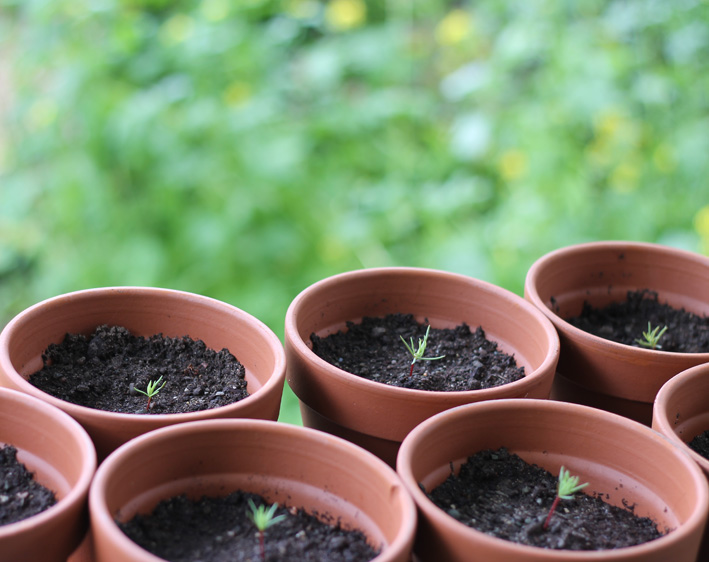
6 Months ago when I started the Coutiver project I selected seeds from the Californian giant Sequoia. After 4 long months of waiting, the little sprouts appear and are now 2 cm in height with some small branch needles only. They have been placed in plant pots this week, and in 2 years I will be able to plant them within nature, to allow them to grow to very old age trees (there is 9 of them in total).


The California giant Sequoia can reach 100m/328 feet and live more than 4,000 years, a tree can absorb 10kg of CO2 per year which give us 20,000 kg for 2,000 years of life!

Each year, seeds of trees will be sowed, taken care of and planted in an agreed space with the local council within parks, wasteland, reforestation or urban city areas.


---------------------------------


J’ai toujours eu une admiration pour les arbres, leur beauté, leur grandeur, leurs secrets ! La plupart des huiles utilisées dans les savons Coutiver viennent d’arbres, parfois centenaires ou rares.


Depuis longtemps, dans certaines cultures, des arbres plus grands ou plus gros que les autres sont réputés pour abriter les esprits d'ancêtres ou avoir des vertus particulières. D'autres sont appréciés pour leur ombre et peuvent abriter diverses cérémonies ou être un lieu de rencontre, de justice. Certains de ces arbres ont un nom qui parfois devient le nom de lieu dit.

A  l'initiative d'individus, d'associations ou de collectivités, des recensements et inventaires sont menés et certains arbres sont classés comme monuments et bénéficient de soins et de protection.

En dehors des qualités incontestables qui rendent certains individus exceptionnels, comme la longévité ou les dimensions, bien d’autres paramètres peuvent entrer en compte. Un arbre qui peut paraître quelconque parmi ses semblables au milieu d’une forêt, isolé il sera remarqué et servira de repère visuel au milieu d’un paysage, planté au milieu d’une place de village, il prendra une valeur symbolique et culturelle au voisinage des générations d’hommes qui le côtoierontSeul de son essence dans une région, il sera distingué pour sa rareté, etc.

La compensation de CO2 par la plantation des arbres est très controversée mais chez Coutiver on y croit. Mais aussi pour l’embellissement des villes, le reboisement des terrains vagues, le développement de la biodiversité ou simplement pour le plaisir de voir grandir d’une si petite graine un mastodonte qui va nous survivre et dont on serra fier de dire « celui la c’est moi qui l’ai planté il y a 10, 20, 30 ou 40 ans ! »


Les arbres font partie d’un équilibre. Ils transforment le gaz carbonique en oxygène, produisent des fruits, représentent des habitats pour la faune, nous protègent contre les glissements de terrain et leur bois est utilisé pour le chauffage, la construction et la production de papier mais participent aussi à la beauté du paysage et sont chargés de souvenirs et d’histoires pour beaucoup.

Il y à 6 mois lors du démarrage du projet Coutiver J’ai choisi des graines de Séquoia géant de Californie Apres 4 long mois de germination , les petit germes ont fait leur apparition et font maintenant 2 cm de haut avec seulement quelques aiguilles. Ils ont étaient rempotés cette semaine et seront plantés en pleine terre dans deux ans (il y en a 9 en tout).


Le Séquoia géant de Californie peut atteindre plus de 100m de hauteur et vivre plus de 4000 ans, un arbre absorbe en moyenne 10 kg de CO2 par ans ce qui nous fait une moyenne de 20 000 kg pour une vie de 2000 ans !

Chaque année, des graines d’arbres seront germées, chéries et plantées par Coutiver dans des espaces convenues avec la mairie de la ville ou la région local, parcs publics, terrains vagues,  reboisements ou embellissements d’espaces urbains.

vendredi 24 mai 2013

What is the organic virgin olive oil in Coutiver soap?


Most of the Coutiver soap range contain minimum 40% of virgin olive oil from organic agriculture. It is known for their moisturising and antioxidant property.

The virgin olive oil soap base gently clean your body and is not aggressive for your skin. Because of their nourishing and softening action they protect your skin from calcium damage and prevent your epidermis from dehydration.


Acclaimed property since ancient times.

The olive oil is known since antiquity. It had already been used for cooking, lighting, clothing and soap making.


What is virgin olive oil?

The famous virgin olive oil  is superior. It contain 99% of lipids which works to make it moisturising.
The organoleptic specifications (flavour, scent, color, aspect, consistence) depend of geographic origin, olive tree variety but also culture method and fruit maturity. It raises as much interest as the great wine. The tastes can be distinguished (bitterness and intensity), and also the aromas ( fruity and similarity with other fruit).
All the vegetable oils naturally contain antioxidants in more or less quantity. This is what protect them against oxidation and us by the same occasion.


Virgin olive oil making :

After being washed the olives are first “triturated”. So you hear you ask but what is trituration? This is a process that combines, crushing, friction, rubbing and pressure (like our molars during the chew action). The trituration is usually made with the pips in a mill wheel (once operated by animals but motorised today) or a hammer mill.
Those are cold processes, which means not above 30°C, this doesn’t cause any alteration of the oil and the process does not contain any other treatment other than washing, settling, centrifugation or filtration.


They are pure fruit juice!

Then comes separating oil from water and solid residues by press or centrifugation which consuming a very small amount of water and energy causing minimum pollution.
Finally the settling and the filtration eliminate the last residues in suspension.
Depending on the olive variety and the maturity we need 4 to 10 kilos of them to provide 1 litre of oil.

The olive oil is a star over the ages and will continue to be for very long!


Christophe Lecoeur
Founder of the ‘Coutiver’ Company